Los nombres o sustantivos contables son aquellos que se pueden contar.
Ejemplos:
one [a] pencil(un lápiz)
two cats(dos gatos)
three houses(tres casas)
Uncountable Nouns (Los nombres incontables)
Los nombres o sustantivos incontables son aquellos que no podemos contar porque no los podemos delimitar individualmente sino que forman parte de un todo. Son tratados como singulares (no se pueden hacer plurales añadiendo “-s”).
Sin embargo, en el momento que los delimitamos, estos mismos nombres o sustantivos pasan a ser contables. Deberán ir precedidos, si quieren individualizarse, de alguna palabra con
valor partitivo.
Ejemplos:
a gram of salt(un gramo de sal)
a piece of wood(un trozo de madera)
two cups of tea(dos tazas de té)
three glasses of wine(tres vasos de vino)
Grammatical Rules (Reglas gramaticales)
1. Nombres contables tienen una forma plural:
Ejemplos:
egg → eggs(huevo/s)
bicycle → bicycles(bicicleta/s)
dress → dresses(vestido/s)
Nombres incontables no tienen una forma plural:
rice(arroz)
rices
milk(leche)
milks
2. Se puede usar “a” o “an” con nombres contables en singular:
Ejemplos:
an apple(una manzana)
a house(una casa)
No podemos usar “a” o “an” con nombres incontables.
What is a Part of Speech?
We can categorize English words into 9 basic types called "parts of speech" or "word classes". It's quite important to recognize parts of speech. This helps you to analyze sentences and understand them. It also helps you to construct good sentences.
short exclamation, sometimes inserted into a sentence
oh!, ouch!, hi!, well
Ouch! That hurts! Hi! How are you? Well, I don't know.
* Some grammar sources traditionally categorize English into 8 parts of speech. Others say 10. At EnglishClub, we use the more recent categorization of 9 parts of speech. Examples of other categorizations are:
Verbs may be treated as two different parts of speech:
lexical Verbs (work, like, run)
auxiliary Verbs (be, have, must)
Determiners may be treated as adjectives, instead of being a separate part of speech.
Parts of Speech Examples
Here are some examples of sentences made with different English parts of speech:
verb
Stop!
noun
verb
John
works.
noun
verb
verb
John
is
working.
pronoun
verb
noun
She
loves
animals.
noun
verb
noun
adverb
Tara
speaks
English
well.
noun
verb
adjective
noun
Tara
speaks
good
English.
pronoun
verb
preposition
determiner
noun
adverb
She
ran
to
the
station
quickly.
pron.
verb
adj.
noun
conjunction
pron.
verb
pron.
She
likes
big
snakes
but
I
hate
them.
Here is a sentence that contains every part of speech:
interjection
pron.
conj.
det.
adj.
noun
verb
prep.
noun
adverb
Well,
she
and
my
young
John
walk
to
school
slowly.
Words with More Than One Job
Many words in English can have more than one job, or be more than one part of speech. For example, "work" can be a verb and a noun; "but" can be a conjunction and a preposition; "well" can be an adjective, an adverb and an interjection. In addition, many nouns can act as adjectives.
To analyze the part of speech, ask yourself: "What job is this word doing in this sentence?"
In the table below you can see a few examples. Of course, there are more, even for some of the words in the table. In fact, if you look in a good dictionary you will see that the word "but" has six jobs to do:
verb, noun, adverb, pronoun, preposition and conjunction!
word
part of speech
example
work
noun
My work is easy.
verb
I work in London.
but
conjunction
John came but Mary didn't come.
preposition
Everyone came but Mary.
well
adjective
Are you well?
adverb
She speaks well.
interjection
Well! That's expensive!
afternoon
noun
We ate in the afternoon.
noun acting as adjective
We had afternoon tea.
ADJECTIVES - WORD ORDER
What is an Adjective?
adjective (noun): a part-of-speech that modifies or describes a noun or a pronoun
An adjective is a word that tells us more about a noun. It "describes" or "modifies" a noun (The bigdog was hungry). In these examples, the adjective is in bold and the noun that it modifies is in italics.
An adjective often comes BEFORE a noun:
a greencar
a darksky
an interestingstory
And sometimes an adjective comes AFTER a verb:
My car is green.
The sky became dark.
His story seemed interesting.
But adjectives can also modify pronouns (She is beautiful). Look at these examples:
They were empty.
I thought it seemed strange.
Those are not expensive.
Note that we can often use two or more adjectives together (a beautifulyoungFrenchlady / it is black and white).
The adjective is the enemy of the noun
This is sometimes said because, very often, if we use the precise noun we don't need an adjective. For example, instead of saying "a large, impressive house" (2 adjectives + 1 noun) we could simply say "a mansion" (1 noun).
Adjective Form
Some adjectives have particular endings, for example:
-able/-ible: washable, credible
-ish/-like: childish, childlike
-ful/-less: careful, careless
-ous: dangerous, harmonious
-y: dirty, pretty
However, many adjectives have no obvious form.
Comparative, Superlative
Most adjectives can be comparative or superlative, for example:
§Para expresar hábitos y rutinas, hechos
generales, acciones repetidas o situaciones, emociones y deseos permanentes: I smoke (hábito); I work in London (permanencia); London
is a large city (hecho general)
§Para dar instrucciones o indicaciones: You walk for two hundred meters, then you turn left.
§Para hablar de eventos programados,
presentes o futuros:
Your exam starts at 09.00.
EJEMPLOS
§Hábitos y rutinas
He drinks tea at breakfast.
She only eats fish.
They watch television regularly.
§Eventos y acciones repetidos
We catch the bus every morning.
It rains every afternoon in the hot season.
They drive to Monaco every summer.
§Hechos generales
Water freezes at zero degrees.
The Earth revolves around the Sun.
Her mother is Peruvian.
§Instrucciones o indicaciones
Open the packet and pour the contents into hot water.
You take the No.6 bus to Watney and then the No.10 to Bedford.
§Eventos programados
His mother arrives tomorrow.
Our holiday starts on the 26th March
§Construcciones de futuro
She'll see you before she leaves.
We'll give it to her when she arrives.
Normally in the present tense we add S to the end of the verb in the 3rd person (He, She, It).
Verb
3rd Person
Speak
Speaks
Play
Plays
Give
Gives
Make
Makes
He speaks three languages.
She drinks coffee every morning.
My dog hates my cat.
Irregular Verbs
Irregular verbs in English in the present tense follow very simple rules. The only change that is made to these verbs is in the third person – for He, She or It.
1. If the verb ends in SS, X, CH, SH or the letter O, we add + ES in the third person.
Verb
3rd Person
Kiss
Kisses
Fix
Fixes
Watch
Watches
Crash
Crashes
Go
Goes
A mechanic fixes cars.
She watches soap operas every afternoon.
He kisses his wife before he goes to work.
2. If the verb ends in a Consonant + Y, we remove the Y and + IES in the third person.
Verb
3rd Person
Carry
Carries
Hurry
Hurries
Study
Studies
Deny
Denies
Isabel studies every night.
The baby cries all the time.
He denies all responsibility.
Negative Sentence
To form the negative we use the auxiliary do not. Again, the only variation occurs in the 3rd person where we use does not.
Positive
Negative
I talk
I do not talk
She talks
She does not talk
You sleep
You do not sleep
He sleeps
He does not sleep
Carol studies
Carol does not study
We study
We do not study
In the negative, the main verb is always in the bare infinitive (without TO). It doesn't change for the third person. We don't put an S on the end of the verb in the negative form. In the examples above - talk, sleep and study do not change in the 3rd person.
He speaks Italian He doesn't speak Italian.
Remember: Do not can be abbreviated to Don't and Does not can be abbreviated to Doesn't.
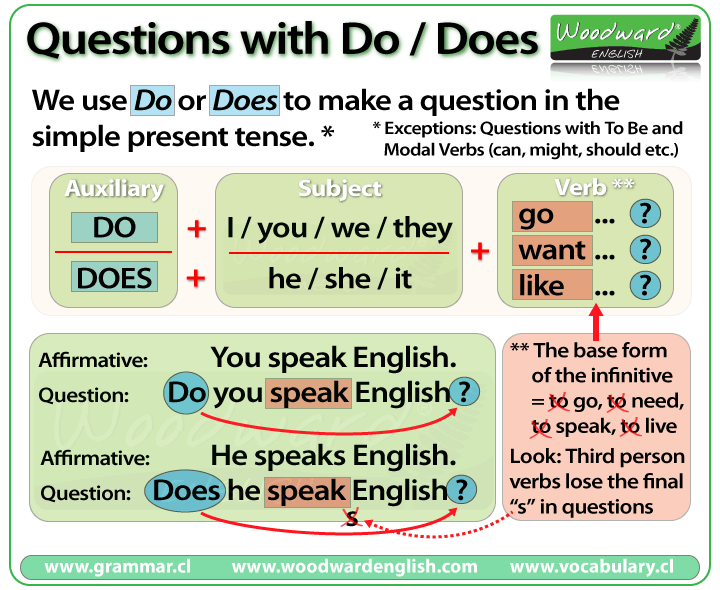
Word Order of Questions with Do and Does
The following is the word order to construct a basic question in English using Do or Does.
Do/Does
Subject
Verb*
The rest of the sentence
Do
I / you / we / they
have / buy
eat / like etc.
cereal for breakfast?
Does
he / she / it
*Verb: The verb that goes here is the base form of the infinitive = The infinitive without TO before the verb. Instead of the infinitive To have it is just the have part.
Remember that the infinitive is the verb before it is conjugated (changed) and it begins with TO. For example: to have, to eat, to go, to live, to speak etc.
Examples of Questions with Do and Does:
Do you speak English?
Does John speak French?
Do we have time for a quick drink?
Does it rain a lot in the South?
Do they want to come with me?
Does she like chocolate?
Short Answers with Do and Does
In questions that use do/does it is possible to give short answers to direct questions as follows:
Sample Questions
Short Answer
(Affirmative)
Short Answer
(Negative)
Do you speak English?
Yes, I do.
No, I don't.
Do I need a dictionary?
Yes, you do.
No, you don't.
Do you both speak English?
Yes, we do.
No, we don't.
Do they speak English?
Yes, they do.
No, they don't.
Does he speak English?
Yes, he does.
No, he doesn't.
Does she speak English?
Yes, she does.
No, she doesn't.
Does it have four legs?
Yes, it does.
No, it doesn't.
However, if a question word such as who, when, where, why, which or how is used in the question, you can not use the short answers above to respond to the question.
Question Words with Do and Does
The order for making sentences with Questions words is the following: